
While major game studios worry about framerates and marketing budgets, Palestinian game designer Rasheed Abueideh is coding under conditions where simply existing is an everyday hazard. Operating out of Nablus in the occupied West Bank, Abueideh has pulled back the curtain on Dreams on a Pillow—a poignant, historical dark-stealth indie project that aims to preserve the memory of a beautiful, vibrant pre-1948 Palestine.
Following a brilliant gameplay trailer drop in mid-May 2026, the project has entered full active production, highlighting a stark contrast between a rich past and a deeply traumatic present.

The Plot: Inherited Trauma and a Fateful Mistake
The core narrative of Dreams on a Pillow centers on Omm, a Palestinian mother fleeing her home during the 1948 Nakba—the mass expulsion of 750,000 Palestinians by Zionist paramilitary groups.
The Crucial Premise: Amidst a violent raid on her village, Omm’s husband is killed and her house is bombed. In a state of pure panic and severe psychological shock, she rushes back into the smoke to save her baby—but inadvertently grabs a pillow instead, fleeing into exile toward Lebanon before realizing her tragic mistake.
The Tension Mechanics: The gameplay splits into a harrowing stealth-survival loop. To evade occupying soldiers and incoming artillery on foot, Omm must navigate dangerous terrain.
The Mind Games: When players are forced to temporarily set the pillow down to interact with environmental switches, Omm’s trauma manifests as terrifying hallucinations and waking nightmares, violently distorting the environment until she safely reclaims her “child.”
Visual Counter-Narrative: Restoring Pre-1948 Beauty
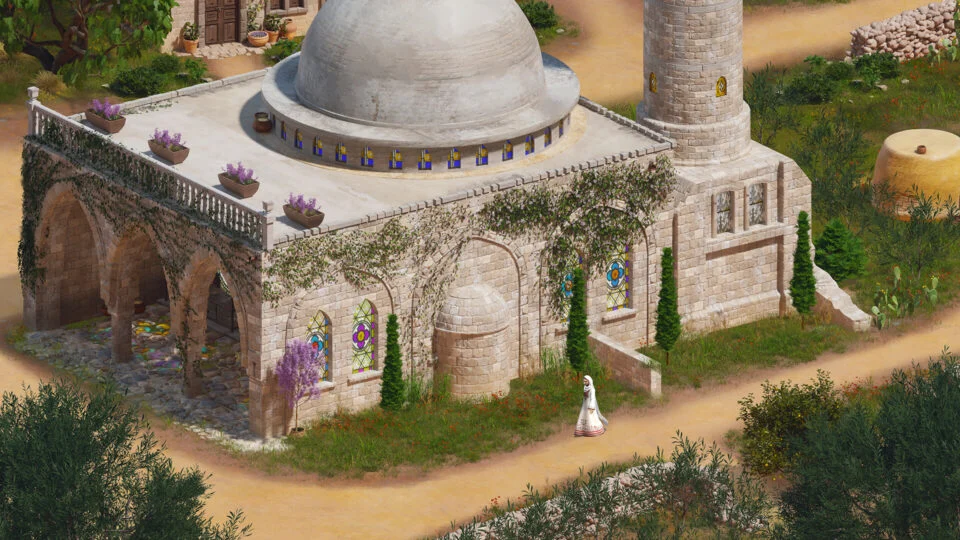
Abueideh is deliberately structuring the game to counter standard news broadcasts that only depict Palestine as a monolith of grey rubble and conflict.
The game heavily integrates vibrant, color-drenched flashbacks to Omm’s childhood in the historical village of Tantura (a real-world town that was depopulated and destroyed during the Nakba, which sits today beneath a commercial resort parking lot). These memory sequences show a Palestine full of life: lush blooming gardens, rich local cuisine, bustling neighborhood markets, and traditional handmade crafts.
“We wanted to talk about Palestine, which is a land full of people, not ‘a land without people for a people without land,'” Abueideh explains. “We needed to show the beauty… and to show the contrast between what happened after the Nakba and what was her life before.”
Production Timeline & True Survival Dev
Abueideh is no stranger to digital advocacy; his 2016 mobile/PC title, Liyla and the Shadows of War, made global headlines when public outcry forced Apple to rescind its ban on the game.
| Project Phase | Current Status / Target | Strategic Resource Allocation |
| Current Campaign | LaunchGood Crowdfunding Round 2 | Aiming for a total goal of $400,000 to keep independent pipelines open. |
| Development Phase | Production Pipeline | Pre-production is complete; core systems, mechanics, and Tantura assets are locked. |
| Target Release Window | Late 2027 / Early 2028 | Approximately 18 months of pure execution and content creation remaining. |
Because of the severe security risks associated with documenting Palestinian history under the ongoing occupation, Abueideh works under intense anxiety, choosing to keep the names of his co-developers, animators, and sound engineers completely anonymous to protect them from arbitrary military detention. Despite constant systemic pressure and local billboards urging Palestinians to leave, Abueideh stands resolute in his refusal to abandon his homeland.